A few people have asked me about the origin of the story Peace River Village. The answer is it came from a dream. A few years ago, I woke up and remembered my dream about a group of police officers who lived on the same street. After I sat up, there was still a cloudy thread in my mind where the officers were working on some sort of investigation. I recalled a lot of funny things in the dream — the detectives were quite the jokesters. That was it — the basis for the book. Over the next day, the detectives became retired and found themselves living on the same cul-de-sac in a fictitious retirement community in Florida. Of course, a crime has to occur to set the story in motion and get our heroes to work on solving the case. And it did.
I especially enjoy world building. For me, the best part of writing a book is the creation of the characters. Over the next few days the good and the bad guys came to life. The first draft was about forty percent longer than the final product, but after several rewrites, some side stories and a few characters fell by the wayside, all in an effort to get those detectives out there faster and save Jennifer. I hope you enjoy the book.
A continuation from the previous blog concerning the LAX task force office space. The story from Shadow Investigation takes place in 1987—a time before personal computers and cell phones (I don’t recall a fax machine in the office either). The means of communication included a teletype machine. A teletype is essentially an electro-mechanical typewriter used to talk to other offices, including headquarters, by sending typed messages. Speaking of communication, we used the standard push button telephone, typically shared by two desks that abutted each other. No rotary dial phones for us—we were cutting edge! And there were handheld radios. Nothing like a modern cell phone. Radios were bulkier, heavier, and unattractive when compared to a smooth, streamlined cell with a fancy case. The radios provided easy point-to-point communication. Depress the button to talk. Release to listen. Unlike cells, there were no “smart” capabilities with a radio except for the brain you carried around in your head!
As I’ve said before, I drew from my experience working at LAX while writing Shadow Investigation. The description in the book of the task force office at the LAX may seem like an exaggeration, but it really isn’t. It was a ramshackle trailer sitting a few feet from World Way, the oval-shaped multi-lane street adjacent to the terminal buildings where passengers started and ended their journeys. My memory of the interior of the office: a messy accumulation of military green metal desks, chairs, and unattractive steel filing cabinets, which were often used more for privacy than storage. Agent-occupied desks all had the standard-issue government planner calendars while unassigned desks were repositories for random junk, supplies, and abandoned Styrofoam coffee cups. The threadbare indoor/outdoor carpet was a color I liked to call ‘old and tired.’ Artwork consisted of a clock hanging on the wall and not much else. The noise level was typically loud, especially in the late afternoon when the day shift gave way to the night shift. This subject to be continued in my next post.
While writing Shadow Investigation, I drew on my own experiences working in federal law enforcement to come up with a fast-paced, high-stakes thriller that I thought would be irresistible to readers, particularly those who enjoy this genre. It was also important to me to write a believable story that would stand up to the critical and discerning eye of law enforcement professionals.
Readers of the early draft of Shadow Investigation asked me where the idea for the book came from. Around the year 1986, when I was a young agent working at the LAX, I heard about a married couple that were boating off the west coast of Florida. They simply disappeared! To this day, I don’t know what happened to them—were they found, rescued, or forever lost?
I didn’t know them, but the incident always stayed with me. Over the years, I built a story in my mind of what could have happened if…. And that was the origin of Shadow Investigation.
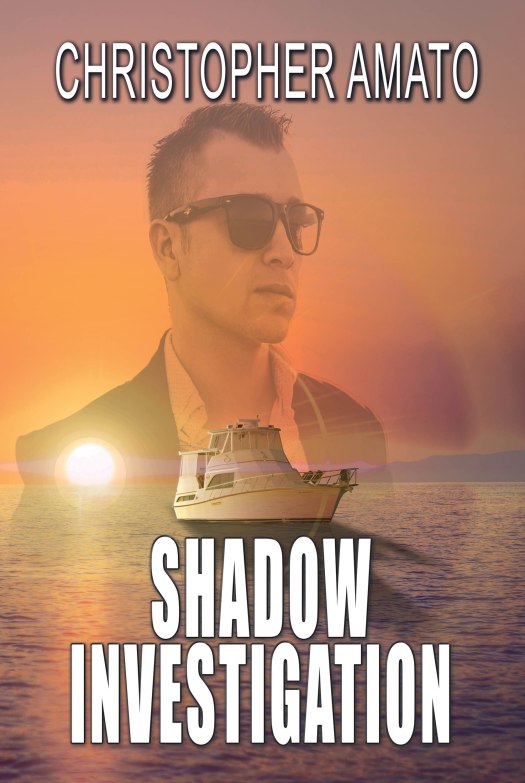
On May 11, 2023, my second book, Shadow Investigation, was published. A crime/thriller, the story takes place in 1987 and focuses on DEA Special Agent Sam Dahl who is assigned to the Los Angeles International Airport (LAX). Sam is comfortable, perhaps even a little bored, with his job seizing drug money from couriers passing through the daily hubbub of the LAX airport. When a friend begs Sam to find out what happened to her parents who disappeared while boating in the Gulf of Mexico, he politely declines. Although Sam possesses well-honed instincts and a keen eye for trouble, he knows nothing about missing person cases, and he has no legal authority to conduct that kind of work while punching the DEA’s time clock.
Eventually, Sam agrees to help and under the guise of taking a long overdue “vacation,” he jumps on a flight to the Sunshine State. It’s not long before his real job and the personal favor to his friend meld into a single investigation. But Sam better be careful, or he could lose his livelihood and his life.
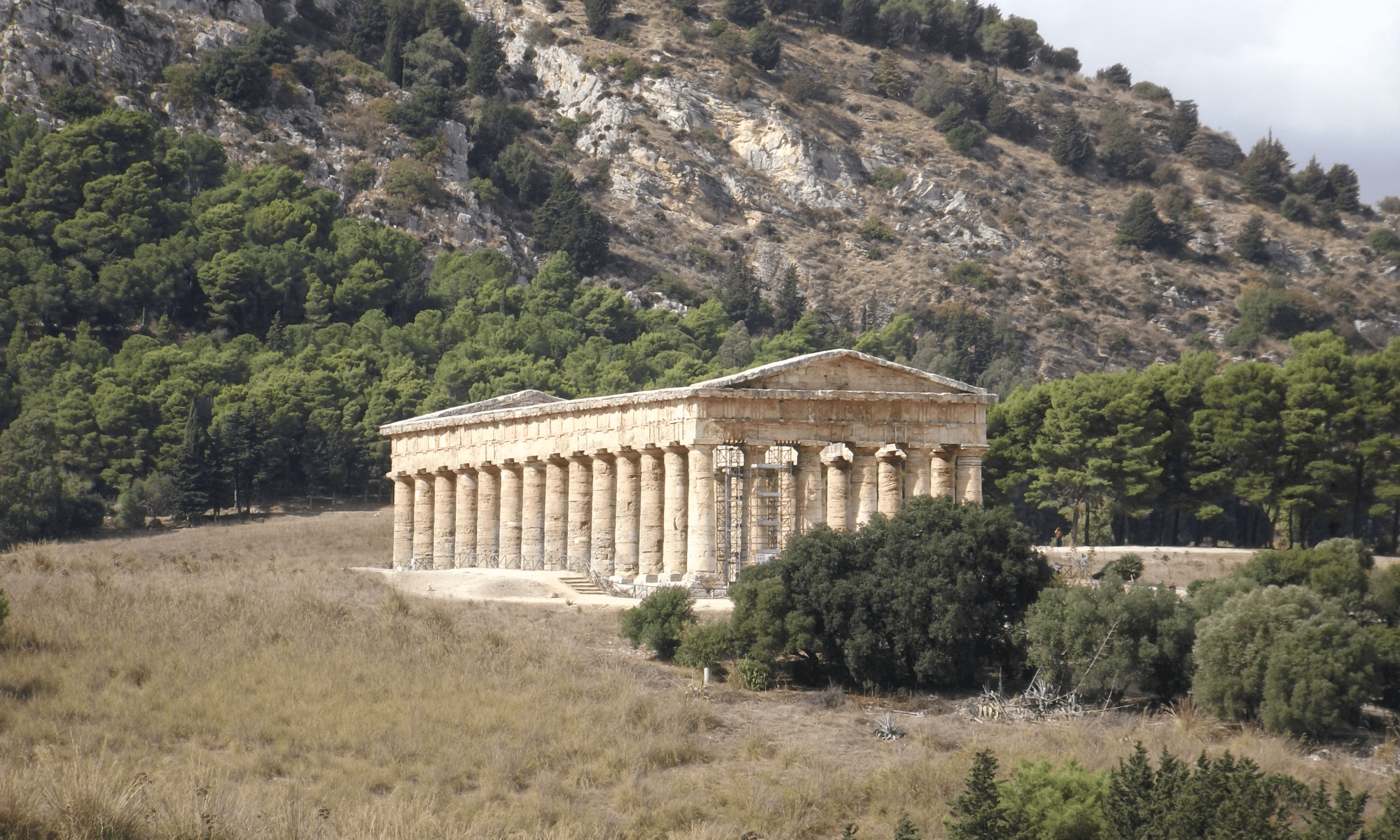
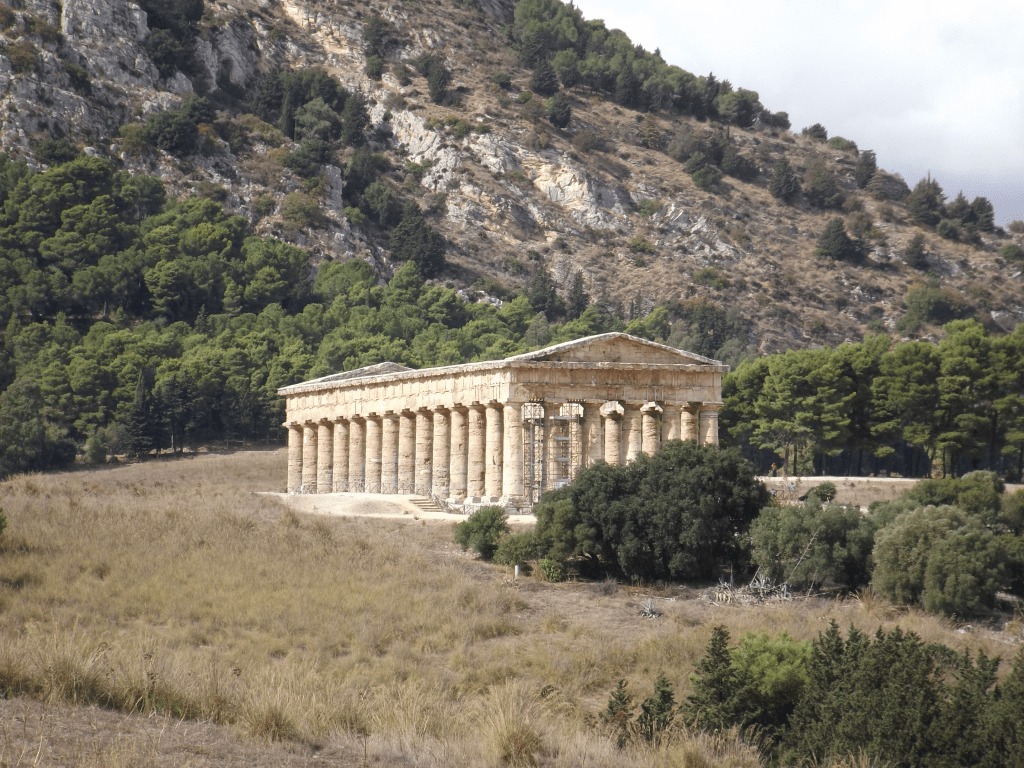
Off in the distance, you can see a remarkably well-preserved but never finished Doric temple.
We’ve been to Segesta a few times. It’s only a thirty-minute drive from Trapani and there’s never more than a scattering of tourists. Amazing because it’s such an idyllic setting, but largely ignored. One thing that strikes me is the quiet. You can find a rock to sit on, close your eyes, and enjoy the peace and calm.
Take note of the absence of a roof. No one knows why the temple was never finished, but as you walk around it, you’ll find yourself amazed at it’s fine condition. Again, it’s quiet, almost eerily quiet.
Segesta, like Erice, was first inhabited by the Elymians. The temple was thought to have been built circa 500 BC. No one knows for certain the origin of the Elymians—modern day Turkey or Greece—but it makes for interesting reading. Segesta’s history reveals a site that was conquered, plundered, and reborn only to be conquered, plundered and reborn again by a list of who’s who of various invaders. The city was finally abandoned in the thirteenth century.
I love to imagine the conversation of these mysterious people from so long ago. Maybe 2,500 years from now, people will imagine what we were like?
In Leaving Marinella, Tony visited Segesta as part of a cultural outing with his classmates at the language school where he studied. Besides achieving the obvious goal of learning a second language, attending a school has another great benefit—seeing varied cultural attractions with native guides who know the sites inside and out.
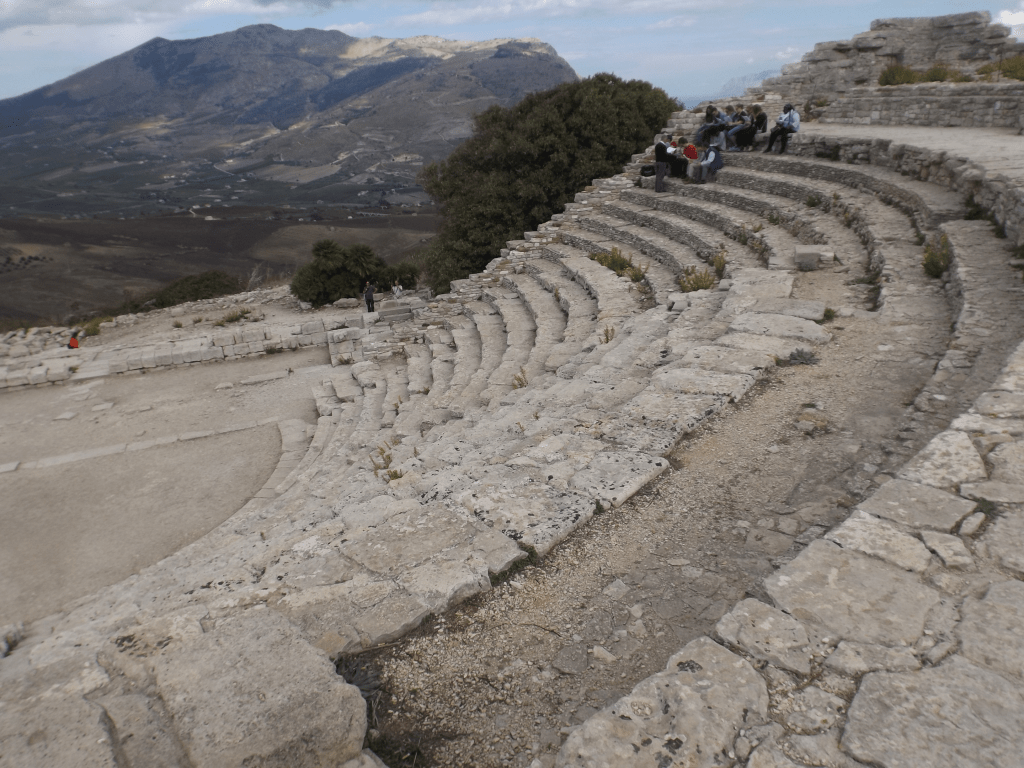
This hilltop amphitheater—thought to have been built in the same period—is just a short walk from the temple . We’ve been there a few times, but I especially recall one occasion when my wife and I listened to a high school group seated in the amphitheater doing a reading of a play.
I’m betting one day years from now these youngsters will look back with fond memories of that special experience.
Favignana is one of five islands making up the Aegadian Islands. Its four smaller sister isles are Marettimo, Levanzo, Maraone, and Formica.
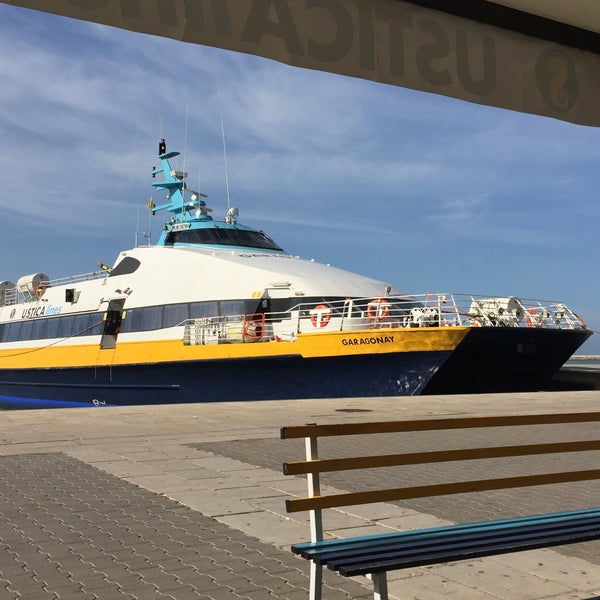
While only mentioned briefly in Leaving Marinella, Favignana is surely a place to be visited and experienced. Sitting about eleven miles off the coast, it is easily accessible by multiple ferries that run to and from Trapani all day. The ride takes about thirty minutes and is a fun little adventure.
I always make sure to pop a piece of anti-nausea gum in my mouth or have my neato gee-whiz bracelet on just in case the waters are rough.
Sleep and my trusty old dog also help with seasickness.
Favignana was famous for its tuna fisheries. Once upon a time, it was one of the world’s largest food processing plants in the world geared toward the canning of tuna. Today, that same industrial complex is a museum.
The island caters to tourists, although we’ve never seen many.
Once you step off the ferry, you can forget the car! If you can ride a bike, there are several vendors as soon as you disembark. The roads and paths are flat and easy to ride on. Don’t worry, though, if you need the help, there are electric bikes available.
Do you remember when you were a kid and could have fun riding bikes aimlessly for hours with your friends? Now you can again! Get a bike and return to your childhood for a day. It’s a real treat.
As you follow well-worn paths and roads, you’ll come across Cala Rossa (Red Cove), famous for the final naval battle between the fleets of Rome and Carthage on March 10 in the year 241 B.C. As the story goes, it was called Cala Rossa because so many dead washed ashore, the area became red from the bloodshed. Not to worry, like much of the Tyrrhenian Sea, the water today is a bluish-green color, and popular with scuba divers and snorkelers.
FYI — the Roman fleet was victorious resulting in Carthage surrendering Sicily to Rome.
Keep on pedaling and you’ll see some lovely homes on the water.
We also stopped a couple of times at the island cemetery to see if we recognized any names. It’s beautifully maintained, but Joanna only took a picture looking away from the cemetery toward the sea.
A beautiful setting for eternal rest.Of course, no island visit would be complete without a cow sighting.
This particular spot isn’t a tourist site at all but still one of our favorite places. We dubbed it “Kitty City.”
Within seconds of our arrival, one by one the cats exited from hidey-holes in the stone wall and through dense shrubbery.
The dumpsters have since been moved. The cats remain.
There are dozens of cats in various shapes, sizes, and colors. We saw random containers with cat food, so they must live there and depend in part on humans to survive. In a way, it was an incredible scene but sad as well. With no veterinary care and no check on reproduction, I assumed these forty were the ultimate survivors. Each visit, we’d stop at the grocery to pick up some food. We discussed moving to Favignana to capture all the cats and have them spayed and neutered. We wanted to take care of them with the hope for a fairy tale ending, e tutti vissero felici e contenti (and everyone lived happily ever after).
Speaking of really cool cats, we found this great young couple hanging out on Favignana.
Our niece and nephew, Ashley and Seth, all the way from some little place called New York City!
Traversing the cobblestone streets of this charming town, I felt like I was walking through a history book. Erice (originally Eryx) began as a settlement of the Elymian people around the year 1200 BC. The Phoenicians, Greeks and Carthaginians came and went, as did the Romans, the Arabs, and the Normans.
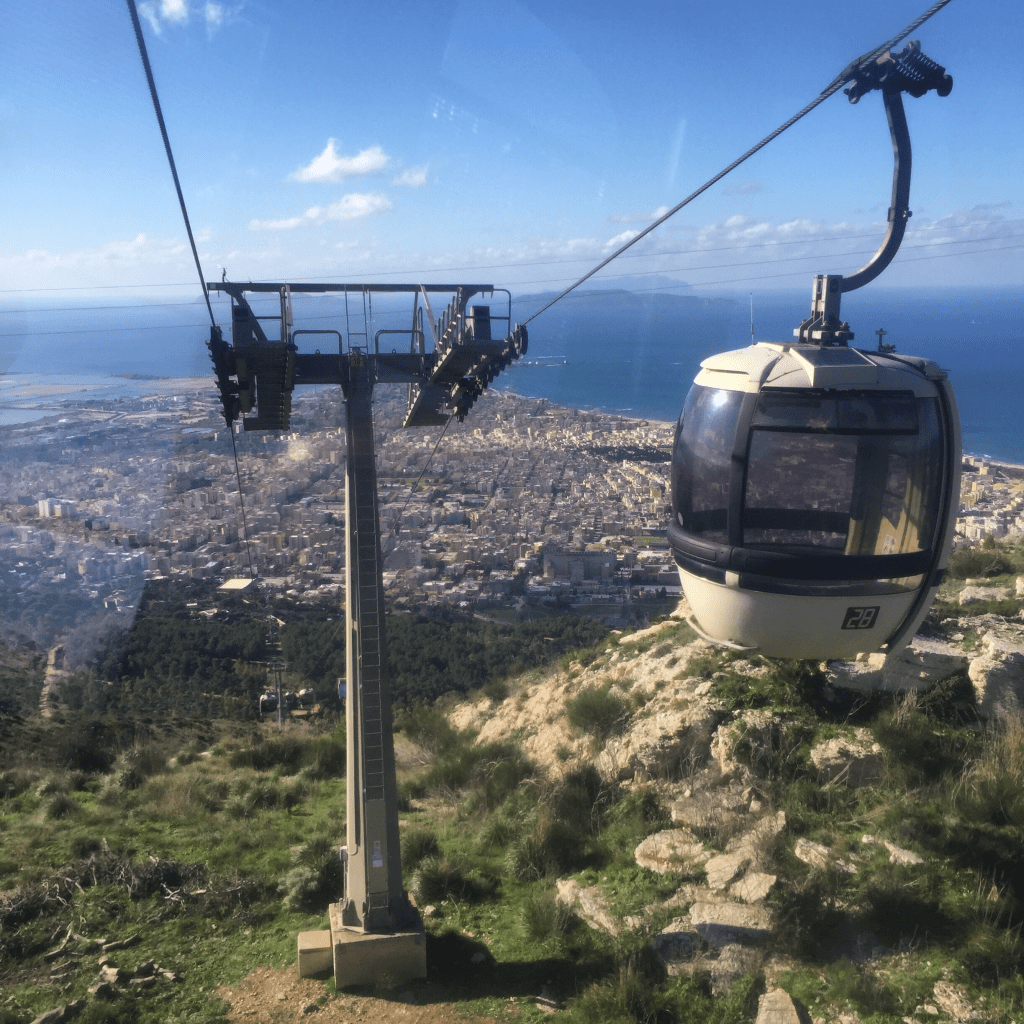
In Leaving Marinella, Tony and Michela visit the town using the cable car line to go from Trapani to Erice. The fifteen-minute ride itself is a must do event. The views are spectacular, and in my opinion, a much better means to reach Erice versus a bus or car.
On our way to the top. Elevation 2,460 feet.
If you still insist on driving a car or taking the bus, the winding roads below are your path between Trapani and Erice.
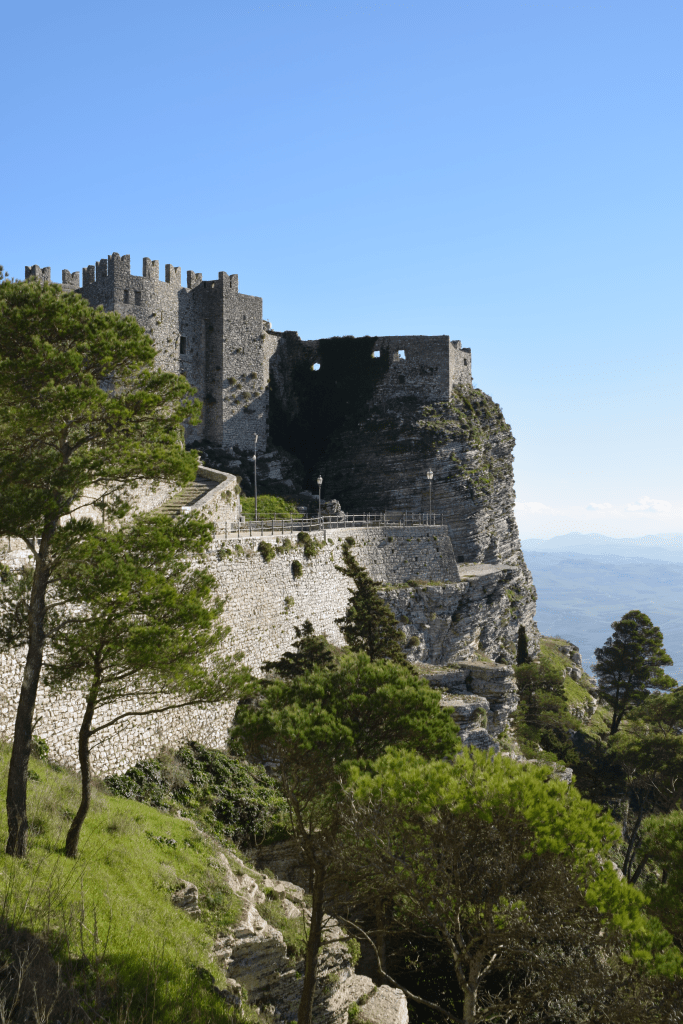
One of the main attractions is the Castello di Venere (Castle of Venus). It was built in the twelfth century AD during the Norman occupation. Note how it clings to the side of the mountain. A visit here will transport you back to the time of its creation.
An engineering marvel from 850 or so years ago, give or take a decade.La Torretta Pepoli
Sometimes described as the little castle located below the majestic Castle of Venus, it was built between 1872 and 1880. So, by Sicily standards, we’re basically talking almost new. Designed by Count Agostino Pepoli, it was used to welcome his literary friends and as a place to study. Today it’s known as the Lighthouse for Peace in the Mediterranean.
Often covered in a blanket of clouds, if you’re lucky you’ll be there on a sunny day; either way, magical is the word that comes to mind when describing Erice.
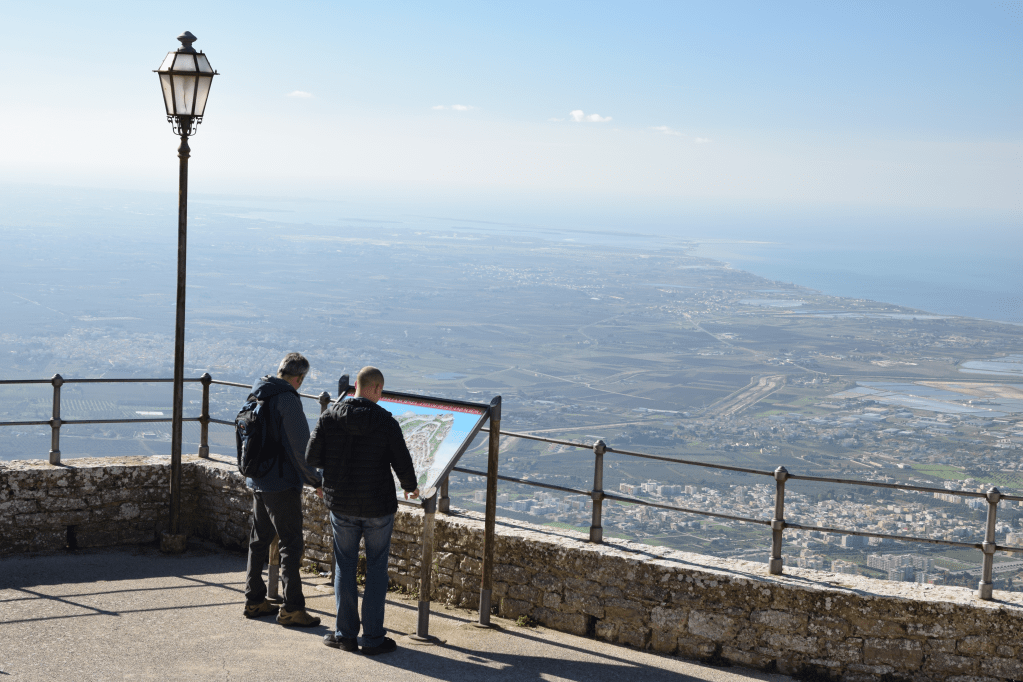
That’s our son Jim on the right. He’s pointing at the map. I think I remember him saying something like, ‘This is where we are now.’
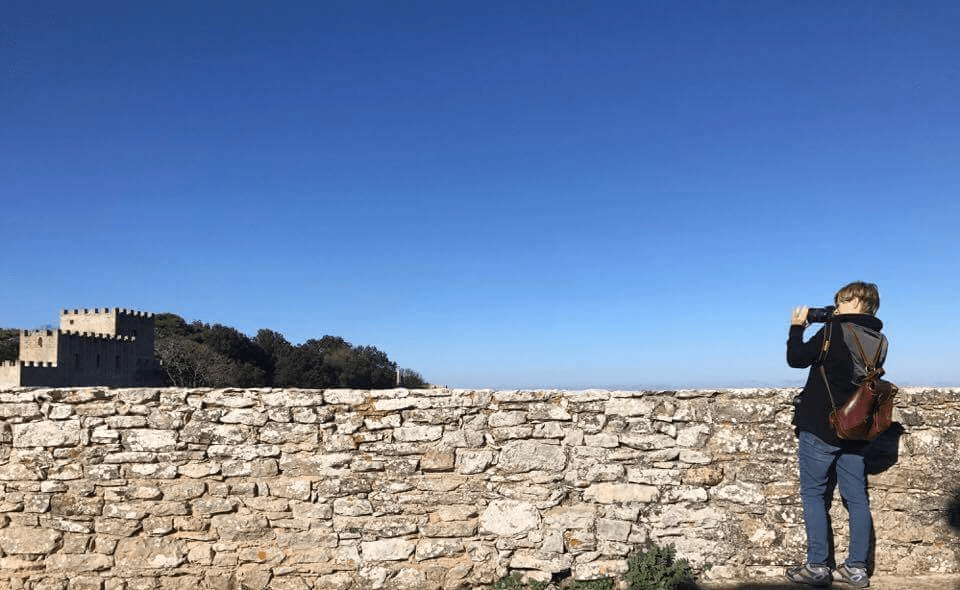
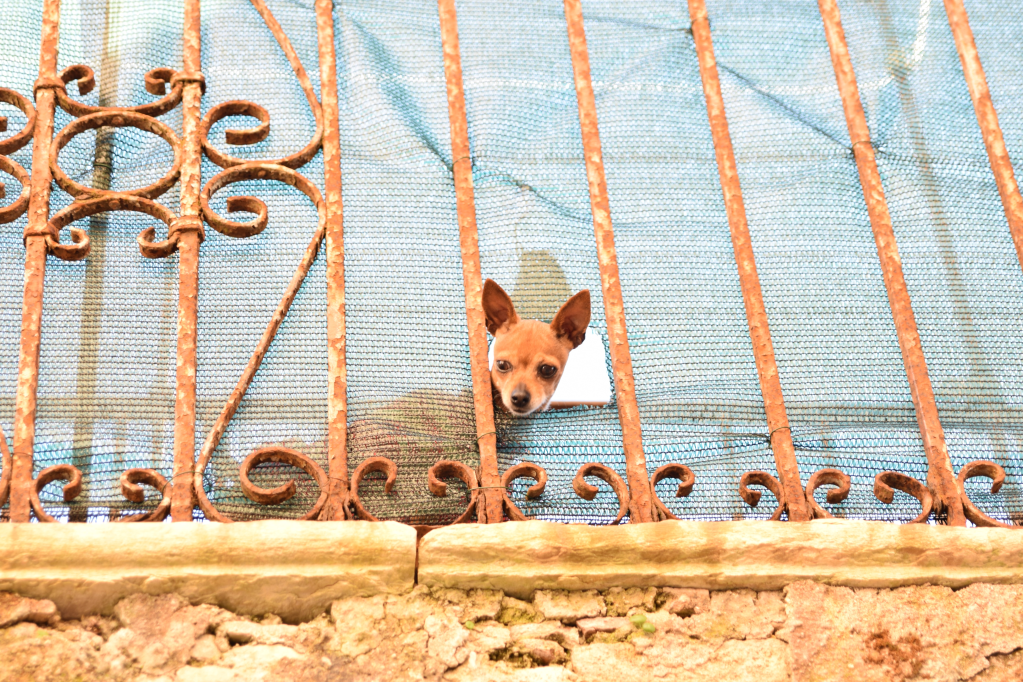
Sneaking a photo of my photographer wife.This little guy was checking out what all the ruckus was about down on the street level.An exquisite view of the coastline
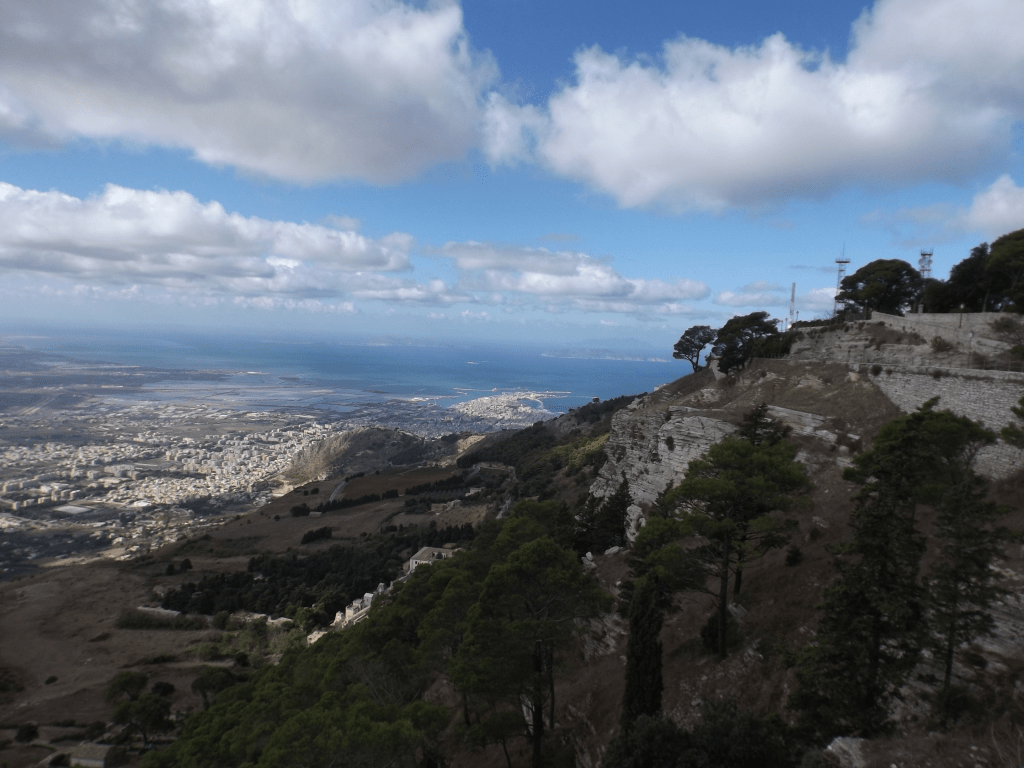
Erice stands watch over Trapani from the northeast and serves as a vantage point of the coastline and beyond, including the beautiful Egadi islands to the west and some claim even Africa to the southwest (less than 100 miles).
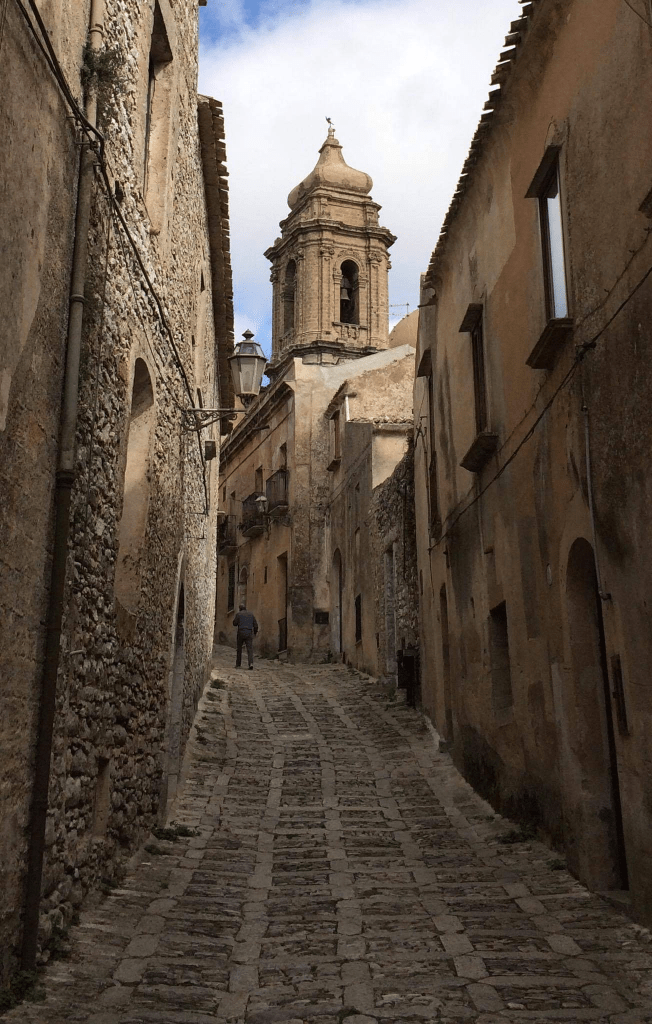
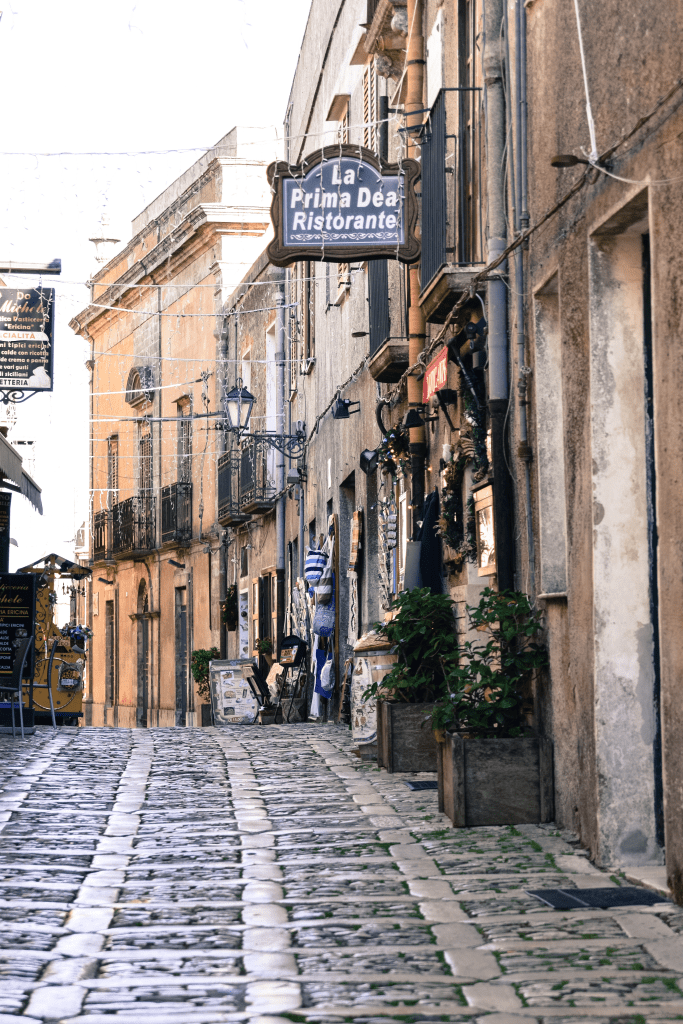
The cobbled streets are a delight to walk in the quiet town.
Great B&W photo of the narrow street. If a car passes, better find a doorway fast.
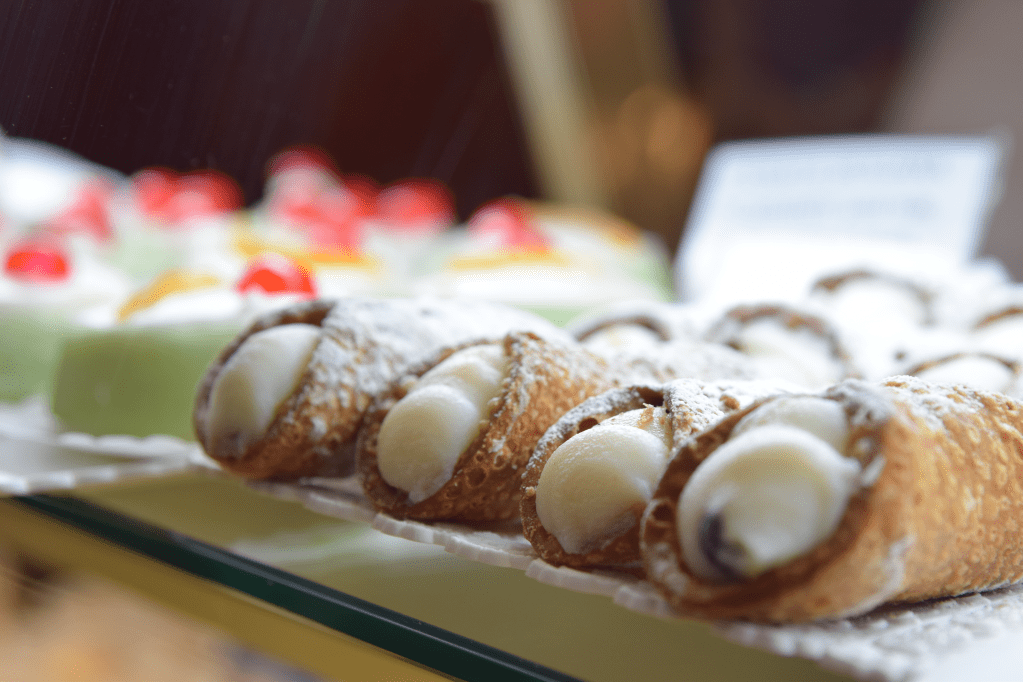
Speaking of skinny, I’m quite certain the merchants of Erice would argue there are no finer sweets to be found, and according to one shop owner we spoke with, it’s because they have been perfected over the years from ancient recipes created by the cloistered nuns who lived in a convent.
On this particular day, we left it up to the shopkeeper to fill a box of cookies for us. I thought he went too far, and we would never eat them all.
Long story short. He didn’t. We did.
These were delicious. I only had several, so it’s hard to remember which were the best.Cannoli your thing? I remember it was very difficult to decide which four I wanted.
Once you arrive in Erice, there is a feeling of remoteness. I suppose that is why every time we’ve frequented a restaurant, we’ve been delightfully surprised at the choices and high quality. Two of our many visits were in the dead of winter with visiting family and while nearly everything was closed, we found a single restaurant open each time and we couldn’t have been more pleased.
You’ll be able to easily spend the day exploring the town. Or stay the night — there are fine accommodations from which to choose.
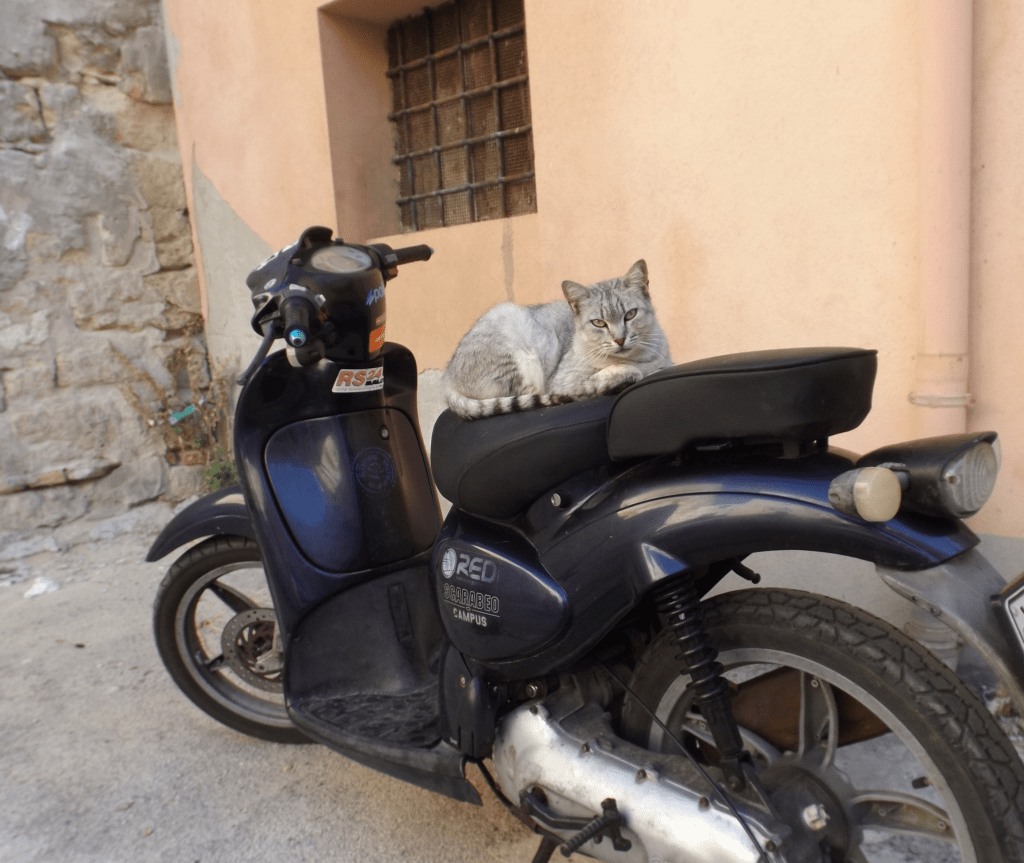
And with a cat-like expression, he mew-used about his day.
"I am not prepared just now to say to what extent I believe in a physical hell in the next world, but a sulphur mine in Sicily is about the nearest thing to hell that I expect to see in this life."Excerpt from the book, The Man Farthest Down, by Booker T. Washington, published 1912
What prompted Booker T. Washington, a former African American slave, to write this?
courtesy of MEDITERRANews
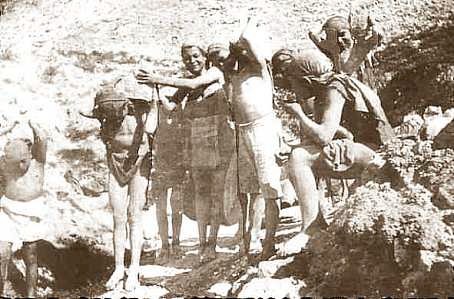
They were known as the carusi, the mine boys. A poor Sicilian family would bind a child to a miner or picconiero, in effect selling their child to work a life of servitude in exchange for a loan that couldn’t ever possibly be repaid. Boys as young as six years of age worked in unsafe, horrid conditions carrying bags of sulfur from deep underground to the surface. Because of the hot temperatures, oftentimes, they were naked or near-naked. Covered in dust, a child might carry a bag weighing in excess of fifty pounds to the surface. His reward was to repeat the process over and over, eight to ten hours a day, six days a week—sometimes for the rest of his life. Although laws were passed in the 1900s to set minimum ages for children, for some it was too late.
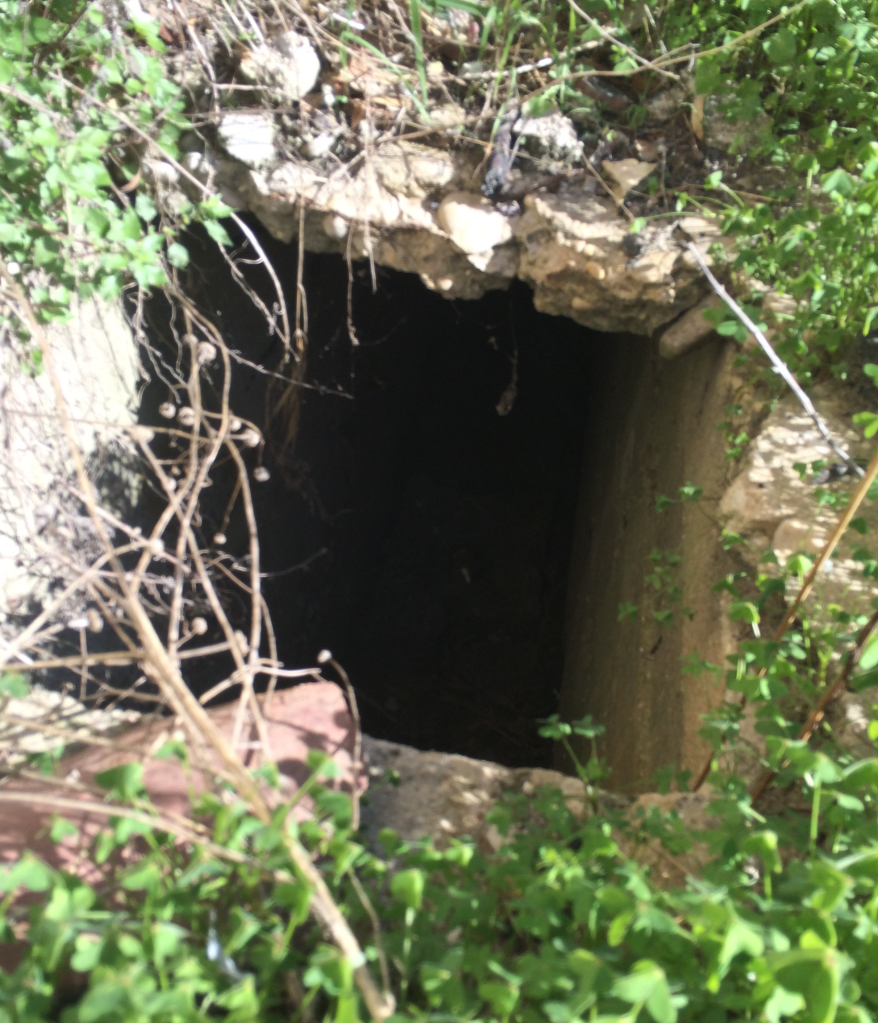
An old uncovered mine shaft.
Sulfur mining operations commenced in Cozzo Disi circa 1839. In the nineteenth century, Sicily had a near monopoly on the western world’s sulfur supply. It was a valuable commodity with many uses, not the least of which was in the production of gun powder.
Sulfur used to be called brimstone because it was thought to feed the fires of hell. Not a bad analogy when one stops to think about the ravaging destruction the forced labor had on the bodies of the carusi. Long term exposure led to partial or complete loss of vision and deformed backs, shoulders and knees.
In Leaving Marinella, Saverio’s fears about his son being forced to work in a mine would not have been at all untrue or exaggerated. It was not uncommon for some to work their whole lives as carusi—living, eating, sleeping, and dying in or near the mines from accidents, tuberculosis, or pneumonia.
Although the mine is closed, this fading road sign serves as a reminder of what used to be.
The abandoned empty shell of a place from the road is an eerie sight indeed. Standing at a fence meant to keep the public out, I couldn’t shake the palpable dreadful feeling that it also served to keep the horror locked in—because once upon a time, it was a sentence to hell for young boys.
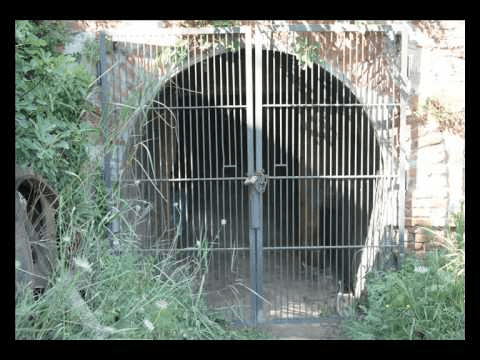
A covered mine shaft
When I closed my eyes, I thought I could almost hear the hundred-plus-years-old cries of pain seeping through the brick covering.
Legend says that Demeter, the goddess of the harvest, was searching for her lost daughter, and, in despair, dropped her sickle to earth. It landed by the sea and Trapani grew in its place — in the shape of a sickle, of course.
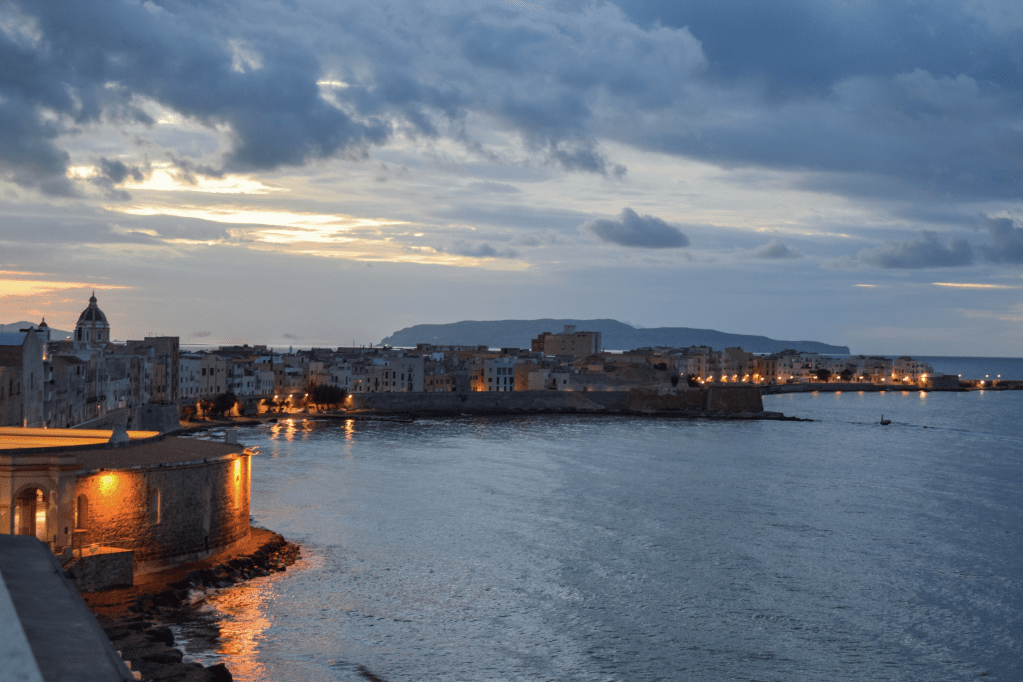
The coastline delicately curves into the sea.
Trapani is not nearly as famous as its cousins Palermo, Catania, Siracusa, and Agrigento, nonetheless, it’s a delightful city in its own right. It’s also a great launching point to the beautiful Egadi Islands, the hilltop magical town of Erice, the Zingaro Natural Reserve, the nearby architectural treasure of Segesta with it’s ancient temple and amphitheatre, and the salt pans, sometimes called Sicily’s white gold.
It’s large enough to stand on its own as a destination, but still small enough to be charming. But hey, if you need to get your fix for big city life, Palermo is an easy ninety-minute drive.
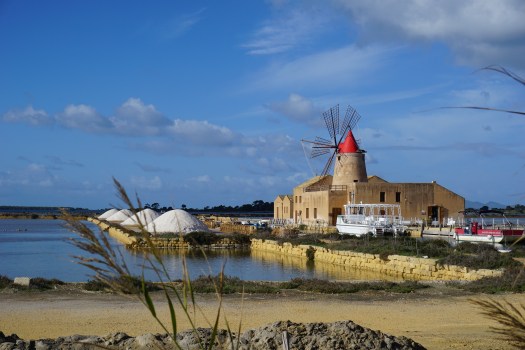
Photo by Joanna of nearby Marsala in the province of Trapani.
2,700 years ago, the Phoenicians were thought to have been the first to use the shallow coastal waters for salt production. Windmills came into use during medieval times, and were used to pump water out of basins, leaving piles of salt.
Trapani figures to be a main setting in the latter part of Leaving Marinella. It’s from this city that Thomas’s grandson, Tony, decides to study Italian for the first month of his stay in Sicily. It’s also here that Tony meets Michela, a captivating woman and irresistible personality.
Unlike Marinella, the fictitious Sicilian town in the book where Tommaso is born, Trapani is real, alive, yet laid-back. When Joanna and I lived in Trapani, we felt like it was our secret hideaway from the world — even though it’s mentioned in travel books.
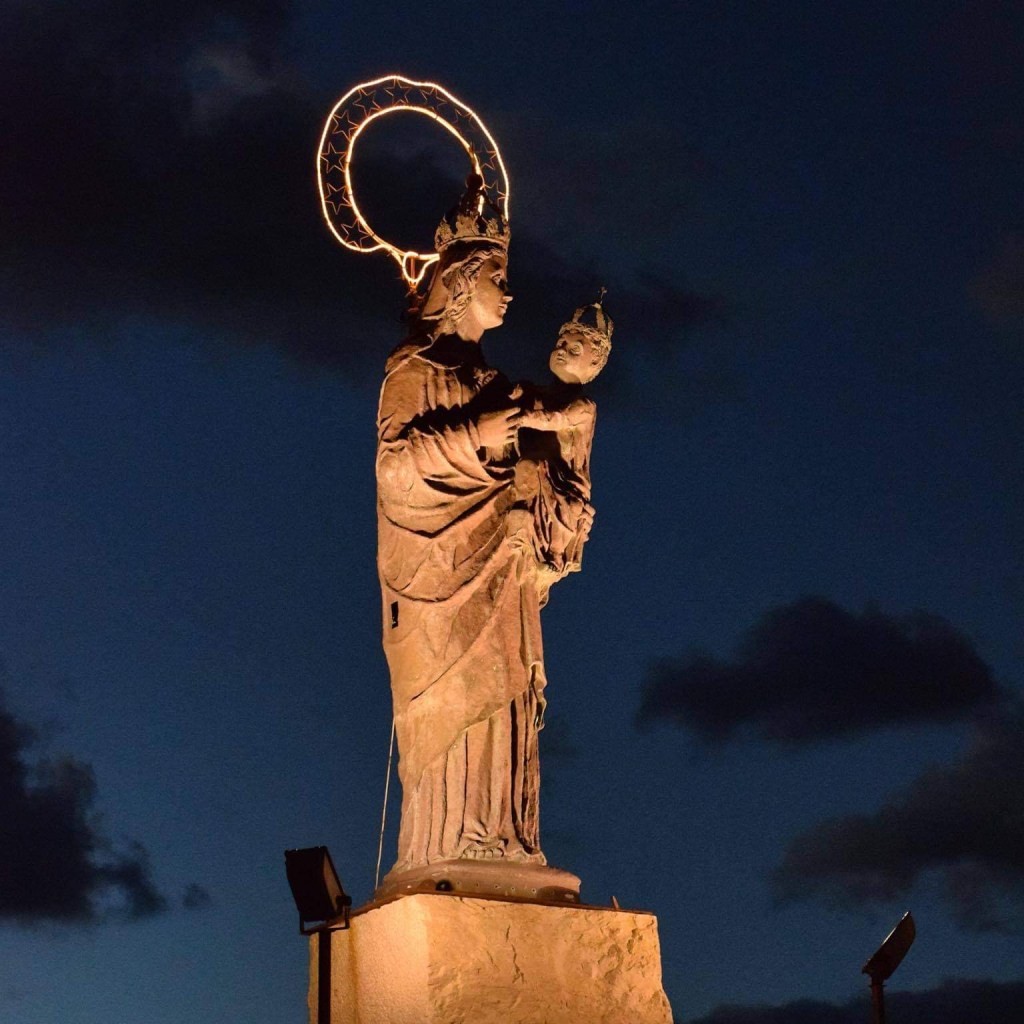
Corso Vittorio Emanuele is a main commercial street in historic Trapani. I’ve worn shoes out walking there.A small square near our residence. Maria Stella del Mare in Piazza Vittime
If you ever find yourself turned around in the city, you can count on Maria Stella del Mare to set you on the proper course. The statue commemorates the thirteen victims who lost their lives aboard a ship called the Maria Stella, which hit a mine off the island of Giglio and sunk in 1947.
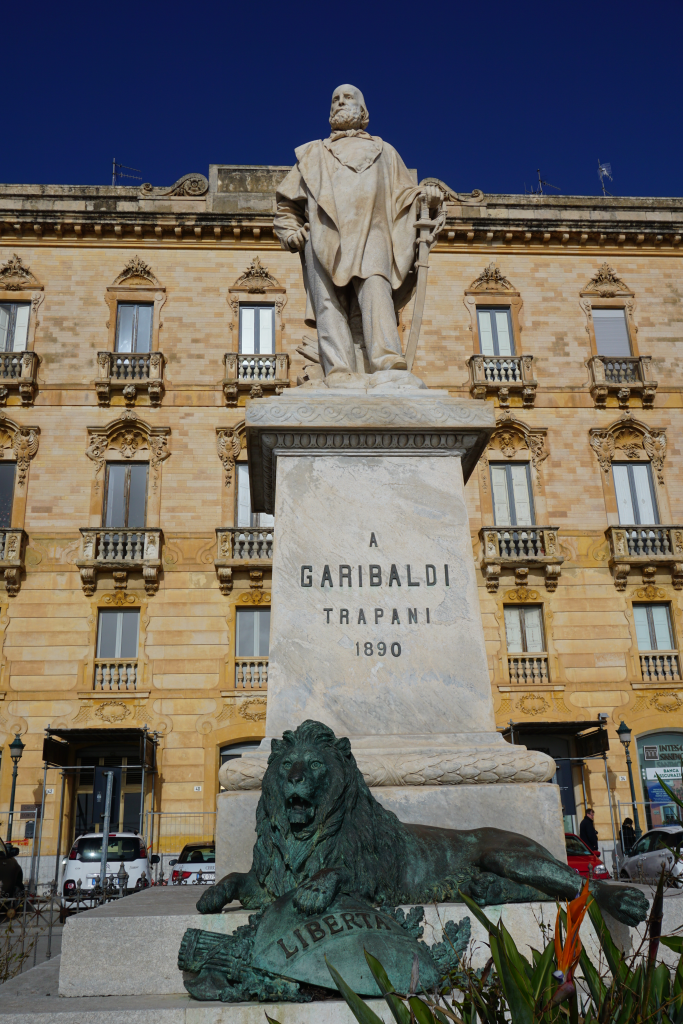
Monument to Giuseppe Garibaldi in Garibaldi Square
The statue of this Italian general and patriot is close to the port of Trapani and serves as a reminder of his significant contributions to Italian unification and the creation of the Kingdom of Italy in 1861.
I loved our evening walks along the seafront promenade.Rain’s a comin’.
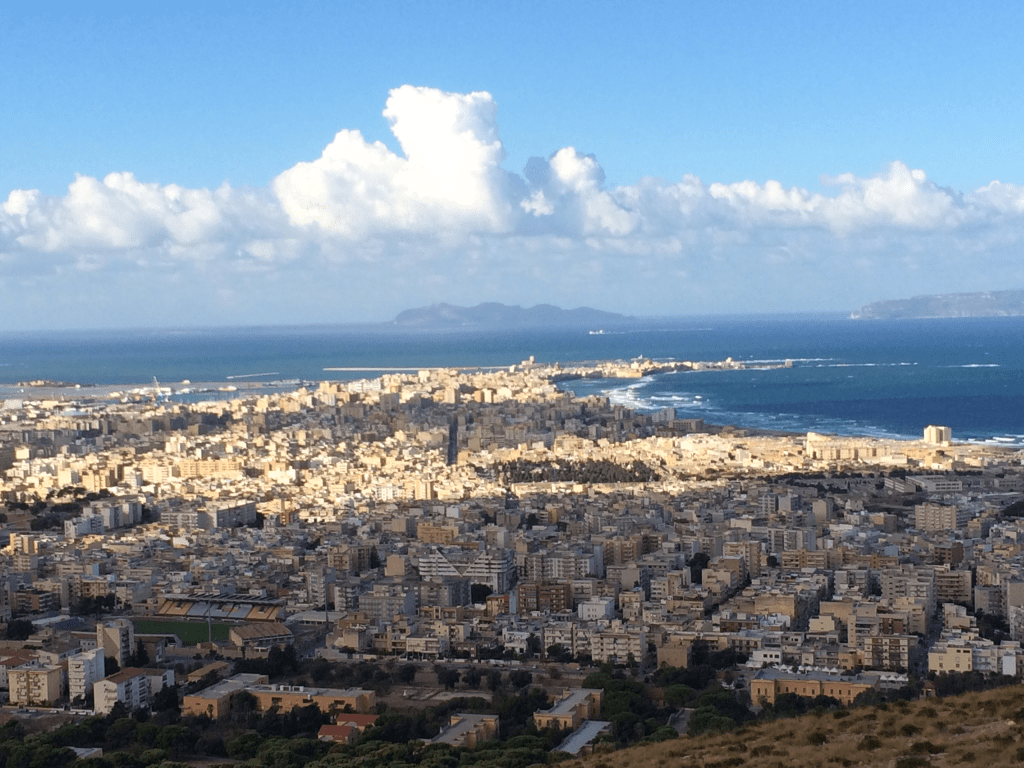
Trapani has a population of 70,000 but it doesn’t seem like it—particularly from the viewpoint of living in the old town. It’s deceptive though, because once you leave the town center, Trapani spreads out like a lawn chair lazing in the backyard.
View from above the city. We’re riding a cableway car from Erice, the hilltop town perched over Trapani.
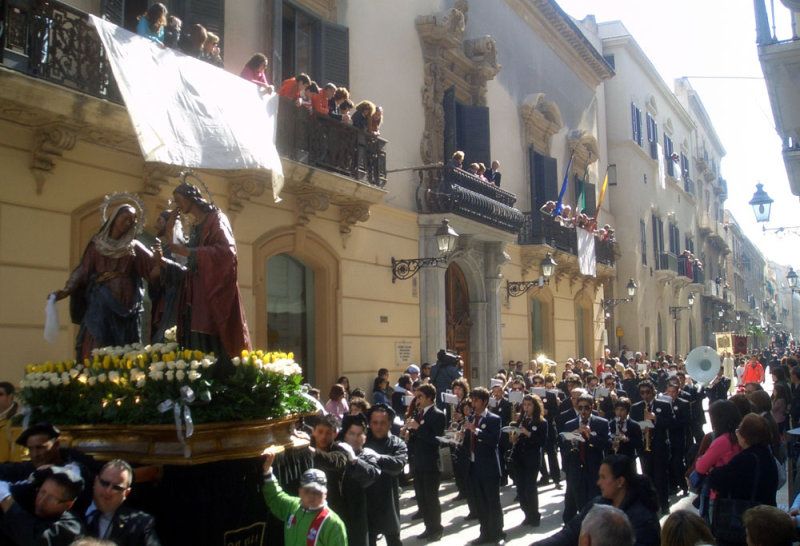
The city is well known for the Easter Holy Week activities highlighted by a procession taking place starting on Good Friday and continuing into Holy Saturday. Twenty floats with wooden statues depicting the passion of Christ are paraded through town.
The event can last more than 24 hours and should be on every visitor’s list.
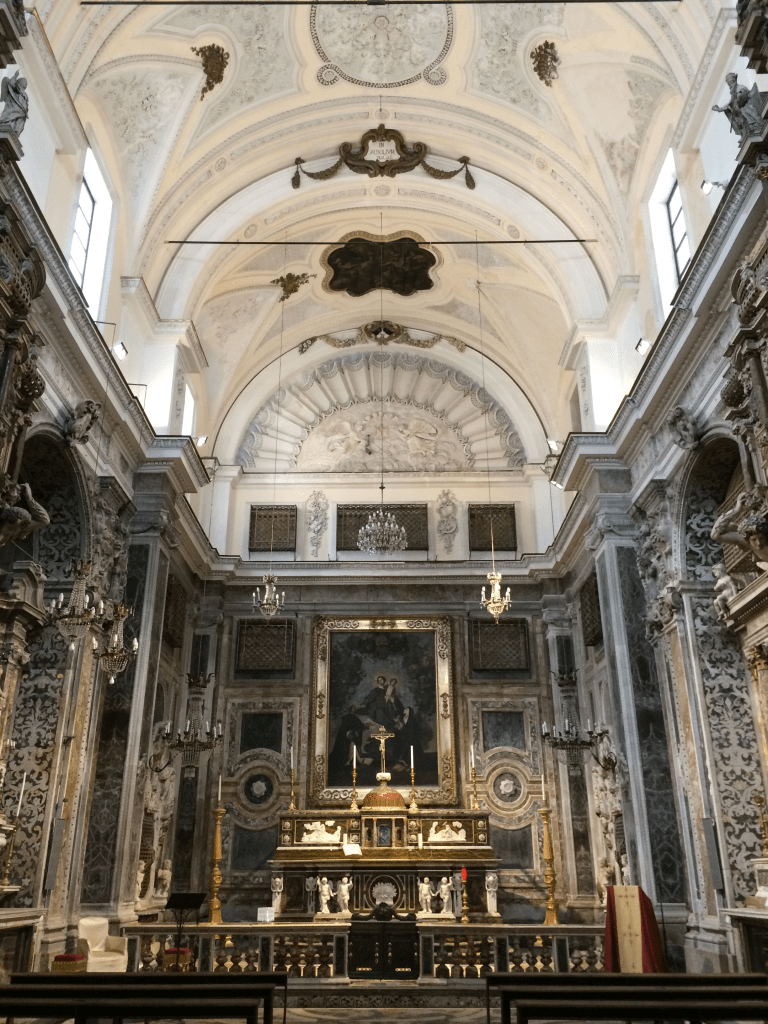
If churches are your thing, you won’t be disappointed. Trapani is known as the city with a hundred churches (so are Erice, Lucca, and perhaps other Italian cities). I’ve never counted but there’s hardly a block to walk by without finding one.
Chiesa di Santa Maria del Soccorso, one of many beautiful churches in Trapani.
There’s also no shortage of fine restaurants. I promise you won’t go hungry.
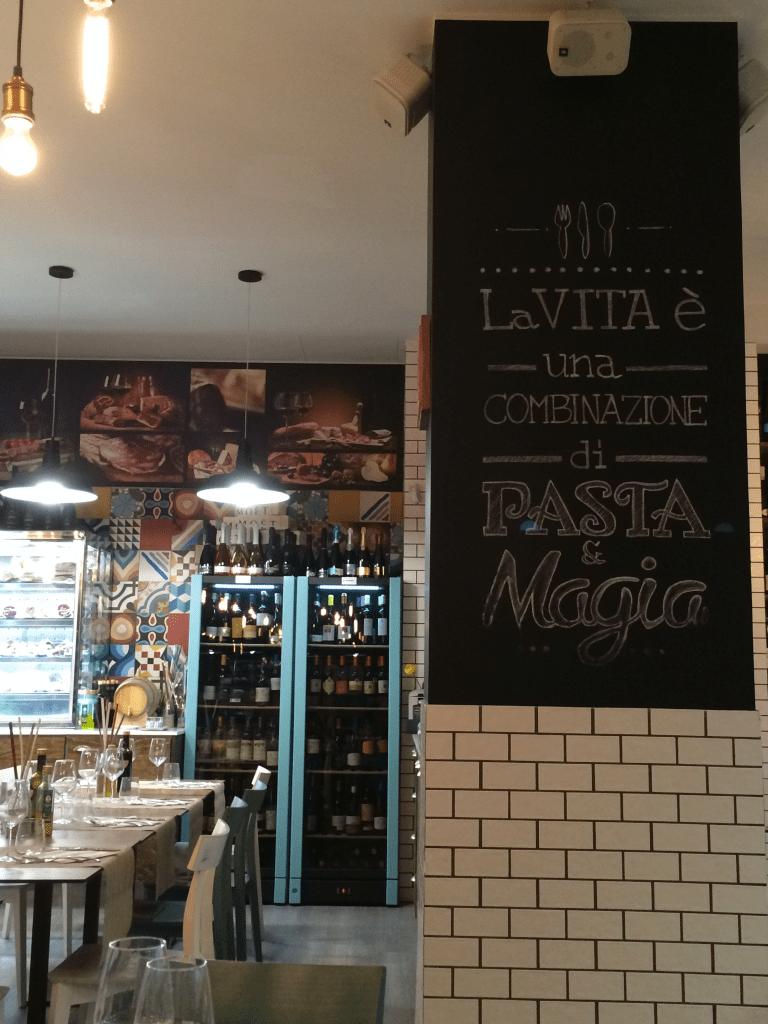
210 Grammi Ristorante Laboratorio is one of our faves and was on our weekly rotation. Fresh pasta is their specialty. I recollect great desserts too!
The sign pretty much says it all. Life is a combination of pasta and magic.
Another of our favorites, Pizzeria Calvino, has lots of personality and great pizza. These pizza chefs, called pizzaioli, know what they’re doing. Intrepid Joanna walked into the kitchen and asked to take a picture. I waited outside — you know, just in case.
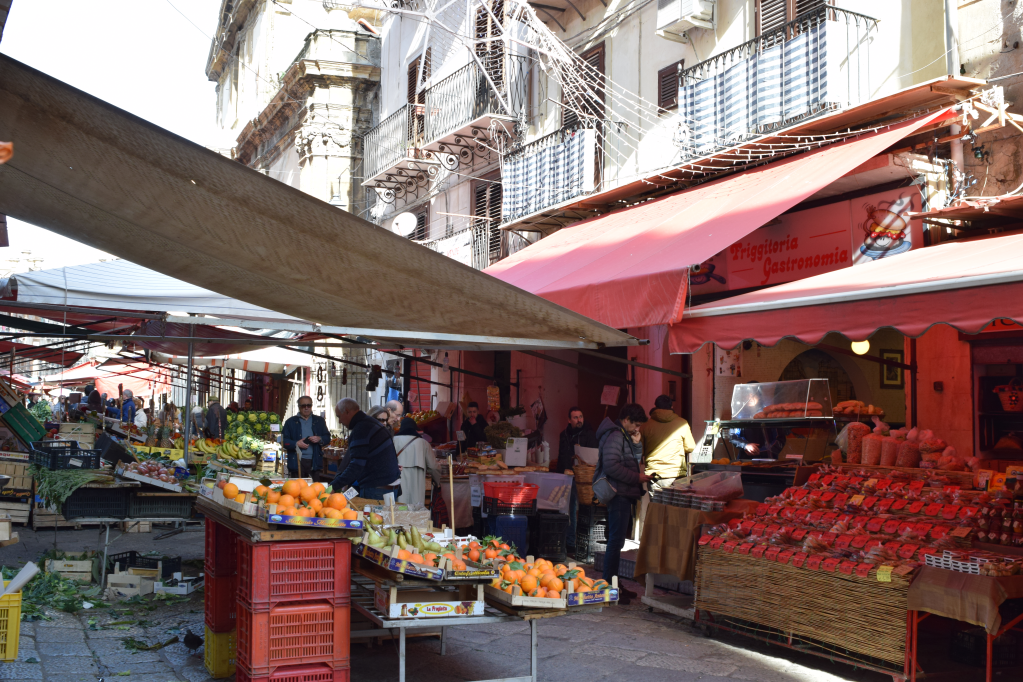
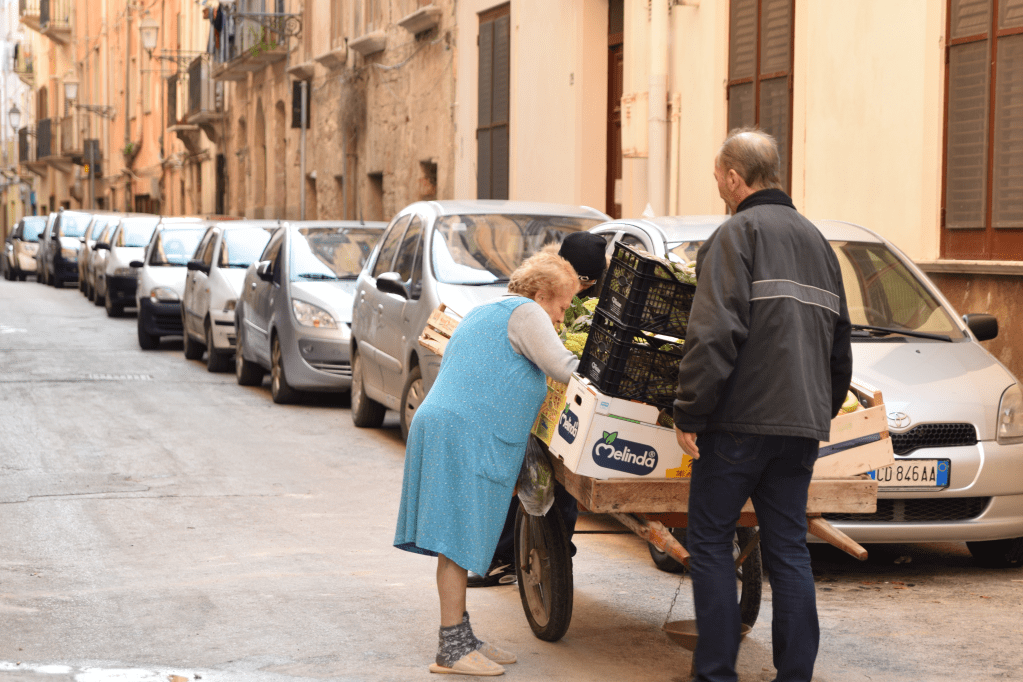
Open-air markets are everywhere for those dinners at home.
If you’re in a hurry, you can buy from the mobile market.
It’s a fine town to tackle by foot; we never got tired of walking the streets. I promise you’ll daydream of dropping out and disappearing into the quiet seaside life whenever you stroll through this historic city.
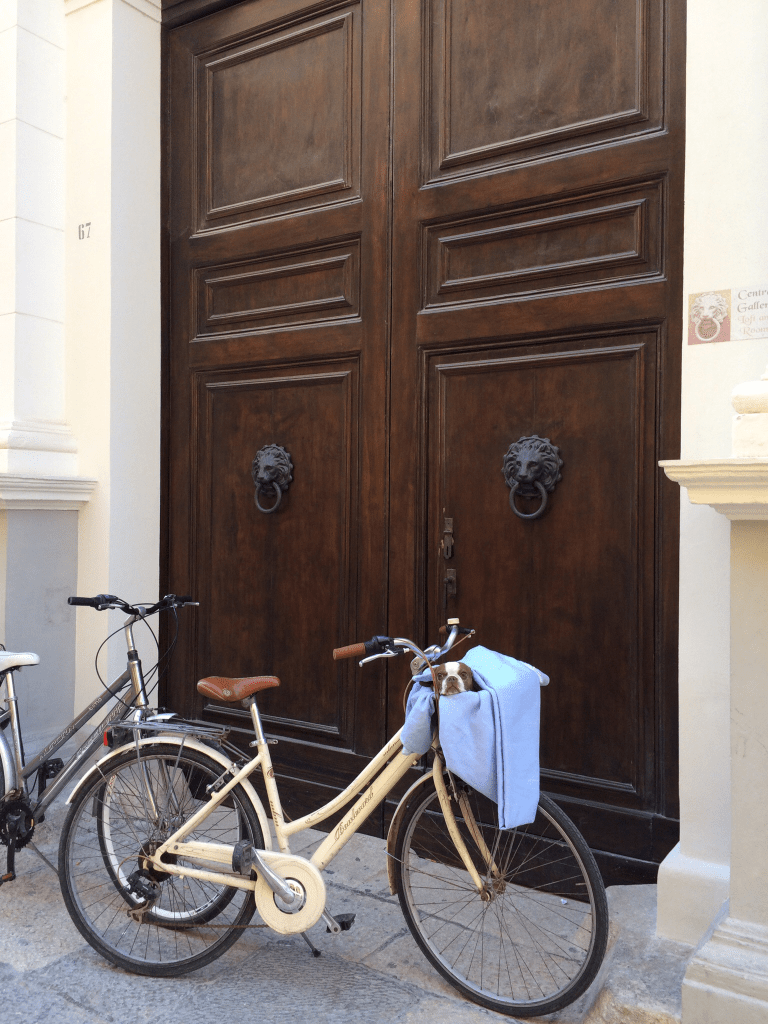
What a grand door leading to our residence.
That’s my little buddy learning how to ride a bike in Trapani, uh, I mean, ride in a bike basket. She’s fearless now.
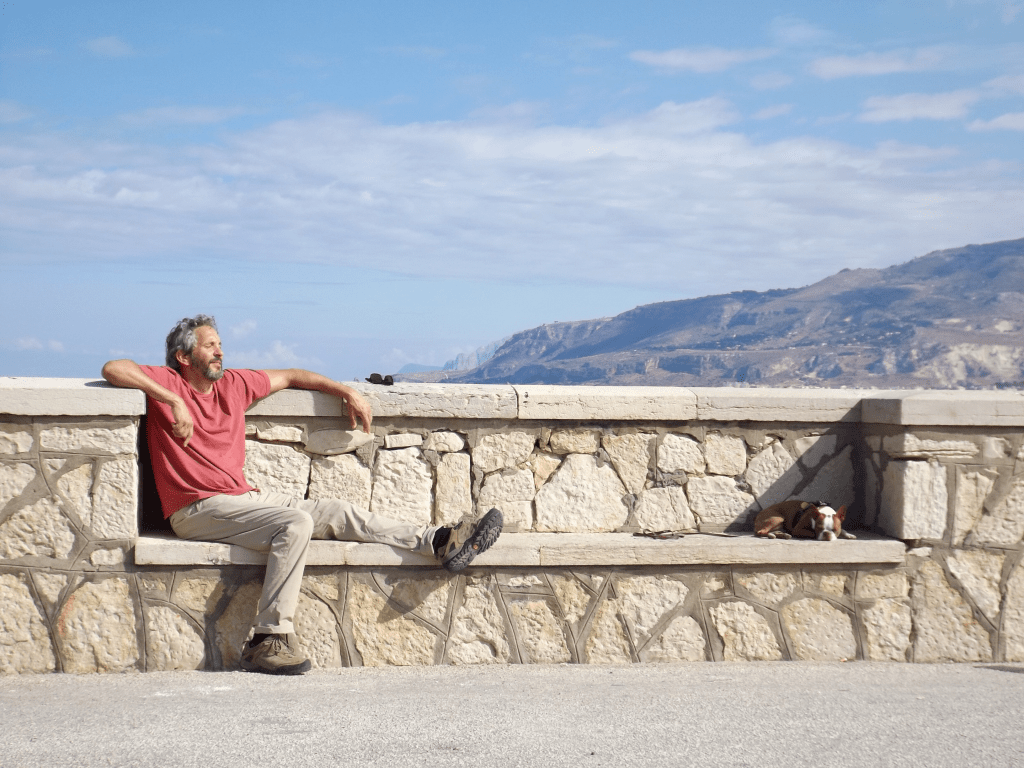
Nice place to catch a few winks with my best four-legged friend.




















 Christopher Amato